Monday, February 23, 2009

Trying to comprehend kids as caregivers

I was emailing my colleague Paula Spencer this morning, talking about my experiences with caregiving and "Divorce, the Sequel" that has roared back onto the scene 25 years after the fact, as my two single parents head into retirement without partners. I wrote that caregiving has transformed the entire way I look at family and work. I had thought that there would be some mythical mellow period of time after my daughter was old enough to be independent, and before my parents needed elder care attention. In reality, as it turns out, there is always something going on in the family realm. Women, in particular, need to be prepared to juggle work and family our whole lives.

So there I was, feeling a little sorry for myself that I had so much responsibility before I had reached age 40, when I was confronted with today's New York Times story about children and young teens caring for their own parents.

Child caregivers. The very notion makes my head spin. While I feel strongly that children should be actively involved family members, they should not have to literally care for their parents and elders.

The Times article, In Turnabout, Children Take Caregiver Role, describes the heavy responsibility and role reversals:

Across the country, children are providing care for sick parents or grandparents — lifting frail bodies off beds or toilets, managing medication, washing, feeding, dressing, talking with doctors. Schools, social service agencies and health providers are often unaware of those responsibilities because families members may be too embarrassed, or stoic.

Some children develop maturity and self-esteem. But others grow anxious, depressed or angry, sacrifice social and extracurricular activities and miss — or quit — school.


What is it going to take to get us to wake up to caregiving in this country? I feel like we're headed toward a cliff at high speed, and we aren't even paying attention to what is right ahead of us. While sixty-something celeb-gurus like Suzanne Somers are writing books called The Sexy Years, and Slim and Sexy Forever, where do "the rest of us" turn to learn how to craft a meaningful reality with family members who are no longer young, rich, fabulous and as frisky and energetic as teenagers? There is a ton of potential but few guides to point the way.

I have resolved to take three steps. First, to explore Caring.com, where Paula Spencer is a founding editor. I am grateful to find these resources. Second, I am learning about the Divided We Fail campaign, a promising intergenerational effort to work for health care reform and long-term financial security. And finally, I am going to read Mother in the Middle, a neurobiologist's account of caring for her mother with Alzeheimer's disease while she was also caring for her own young family. I've been avoiding that kind of realistic memoir, which may be the honest guide I say I've been looking for.

This conversation will continue....

Labels: , , , ,

Tuesday, January 27, 2009

Is elder care more difficult than child care?

I am at an interesting place on my life path right now. My daughter is nine, and I feel that I am standing on a little hill that allows me to see all the way back to the day she was born, while also being able to look ahead to the day she grows up and leaves home.

My parents are in their later sixties and two of my grandparents are still living, in their nineties.

When elder care issues arise, they can come on quickly, forcefully, and unexpectedly. I have heard elder care described as "the joker in the middle-class deck of cards." I urge you to talk about elder care planning with your own parents, to lessen the impact of a crisis.

We urgently need to grapple with these issues as a society. I truly feel that as the Baby Boomers age, we'll either find a way to deal with these issues in a sustainable way, or else it has the potential to crush us economically, emotionally, and spiritually.

Here are some factors that make elder care more challenging in many ways than child care.

It can turn the child-parent relationship on its head, which feels bad.

When you are a parent raising children, it's natural to be the one in charge. When you become an adult child trying to help your parents, that dynamic can get reversed to some extent, whether you want it to or not, which feels really bad. And the generational layers really get stacked up. At age 40 you may be a mother and a daughter. At age 65 you may be a grandmother....and still also a daughter with primary caregiving responsibilities.

It's expensive.

Long-term care in the Raleigh area costs an average of $180 a day, or $65,700 a year. That's like having multiple kids in college at once (and by the way, this need might arrive just as your kids are going to college).

It can arise as a crisis.

Earlier this month I listened to a panel of adult children talk about caregiving, and they all had stories that went something like this. "My mother was living on her own, and that worked well for a while, and then one day...." Any number of crises arose and the children had to put their lives on hold to figure out what came next. I am a big proponent of planning head for these situations, but the truth is that no matter what, if your parent has a crisis, it will feel like a crisis to you, too. But the magnitude of the crisis can be lessened by having a care plan in place ahead of time--for instance, getting elders settled in a retirement community to make friends while they are healthy, and for you to have a wide and deep support network of your own.

When a crisis occurs, whether it's health related, job loss, financial meltdown, or divorce, your parents may suddenly need a lot of care, time and energy. I have come around to the point of view that women should try their best to develop a career amidst caregiving concerns, whether it's children or parents, because these issues never really go away. If you are waiting for a perfectly calm time in your life to arise before you go back to work, that time may never come.

It could last longer than raising kids.

Your kids are likely to be out of the house in about twenty years. Your parents' elder years could stretch for 30 or 40 years. That's why their life situation absolutely needs to become sustainable. Unfortunately, our current ideas about retirement don't really account for thirty years of post-employment living. So people will need to work longer and save more. Not an easy thing in this current financial crisis when retirement savings have been slashed.

It's not optional.

Neither is raising kids, in a global sense. But everyone has parents, whether they see themselves as caregivers or not. In the long run, the fact that caregiving is not optional is potentially a good thing, because it means that we'll all have to deal with family caregiving, which means it might finally get some public policy attention. The bad news: the work of caregiving still falls mainly on the women in the family.

It brings up old family issues again.

Finally, it's one of those ironic life lessons to see that old issues you thought you had come to terms with suddenly make a comeback. For me it's been my parents' divorce. They've been divorced for 25 years and I made peace with that long ago. But now that they are reaching retirement, both single again and newly trying to co-exist in the greater Triangle area, I feel like "It's baaaaaaack!" The logistical and financial issues of divorce have come to light again. For one thing, they know they're not both coming to live with me (which means that pratically speaking, neither of them is coming to live with me). A married couple can enter retirement living together for much less than two singles. So for my parents, if they needed skilled care and didn't have long-term care insurance, it could cost a total of more than $130,000 a year. Also, divorced women who were "displaced homemakers" may find that their Social Security payments are a lot less than their ex-husbands'. Women are likely to live longer yet often have less Social Security and pension benefits.

So thankfully, each of them now has them long-term care insurance. When that was accomplished recently, that I immediately felt a weight lifted slightly off my shoulders. (Did I mention that I am an only child? The buck stops here in all sorts of ways.)

I wish I could wrap up with an uplifting life lesson, but the truth is that I really have not come to terms with all of this yet. I have been pretty immune to feeling Mommy Guilt, but I feel crushing daughter guilt at times. Of course I love my parents and I am really fortunate to have them living nearby--that's a good thing. But the crises wear me down, they can't be timed or planned. The crises piled on in the last six months. Last fall my Dad needed me, my Mom needed me, I was finishing my book, and I was recovering from my unplanned appendectomy. And yes, my husband and child needed me, too, even as they took really good care of me.

I am sad that the easy time is over, and I didn't even recognize the easy time when it was happening. (It all depends on the definition of easy, too.) This new phase of my life feels like it has many off-ramps that lead to depression. I can see how people let themselves go in middle age, losing their mojo once again, preferring to be distracted and numb, and I am determined not to let that happen. I want to enjoy my life and the time my family has together, as much as possible.

This is probably the most downbeat blog post I've ever written, but I wanted to be honest with you and not sugar-coat it. I am in the midst of the maelstrom and haven't found my firm footing yet. Your thoughtful replies and perspectives are most welcome....

Labels: , ,

Thursday, July 03, 2008

A powerful coalition for caregiving

Yesterday I wrote that our best chance to get family caregiving taken seriously will be to create a coalition with Boomers facing the challenge of caring for their elderly parents.

This morning I discovered that The New York Times launched a new blog on July 1 called The New Old Age. The initial post by blog author Jane Gross clearly struck a nerve as evidenced by the fact that it has received over 550 comments so far.

In her follow-up to her first post, Gross said,

Striking to me in your responses is how desperately adult children want to do right by their parents, how desperately their parents want to spare them this burden, and how the American health care system and our government’s safety net for the elderly make this all but impossible for both generations at almost every turn.

The heartfelt sharing on The New Old Age blog sounds a lot like the caregiving conundrum that parents of young children face. I am saddened by the problems families encounter, but heartened at the possibility of creating a coalition. Let's work together on these issues. 77 million Boomers plus young parents? We could really get something done.

Labels: , , ,

Thursday, November 01, 2007

Why is a failed executive "worth" 160 teachers' careers?

I have to hope that we are about to reach a tipping point in this country, where we wake up to what is really going on around us. Ordinary families' bread-and-butter issues don't automatically translate into sensational news segments, but we need to wake up to the fact that families aren't doing as well as they should.

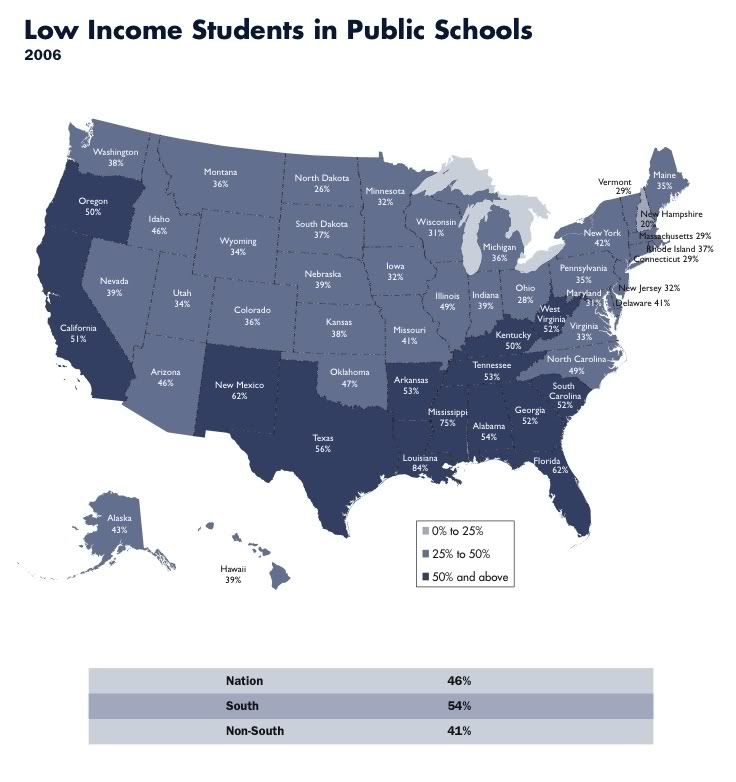
Families did make headlines in the South this week, were a new study revealed that for the first time in four decades, low-income children make up a majority of public school students. The "majority" statistic is what made the news, but if you look at the national map, 49 out of 50 states have a low income student rate of more than 25%.


The national rate is 46%. Unacceptable, any way you slice it.

We also learned this week that fired Merrill Lynch CEO Stan O'Neal is receiving $161.5 million in stock options and retirement benefits. This is not a successful CEO; this is a guy whose financial bets on the subprime mortgage market resulted in an $8 billion loss and "risked the entire franchise," according to financial guru Jim Cramer, speaking on The Today Show.

How much is $161 million? A teacher making $40,000 a year, working for 25 years, would earn a million dollars in a lifetime. So we've come to the point where a losing CEO is valued at more than 160 times the LIFETIME EARNINGS of a full-time teacher.

I don't have the solutions to this conundrum but it's clear that our national/economic priorities are totally screwed up. It's time we all take a grown-up look at the future of families. Between the expensive and demanding crunch of child care, and unbelievably expensive elder care, I fear that many families are headed for worsening crisis in the near future.

I'll be writing more about this, but in the meantime I encourage you to read mothers' real-life stories posted this week at MomsRising.org. I also highly recommend the October 23 episode of The Diane Rehm Show talking about long-term health care for seniors. Her expert panel talked about alarming trends including an investment trend in health-care communities that sounded like it could do for nursing homes what subprime mortgages did for the real estate market. (Don't take my word for it; listen to the show.)

This may seem like dry policy but it is really important stuff. 78 million Baby Boomers are headed for their elder years. When the caregiving bomb explodes, the repercussions are going to end up in our laps as mothers, wives and daughters.

Labels: , , , ,